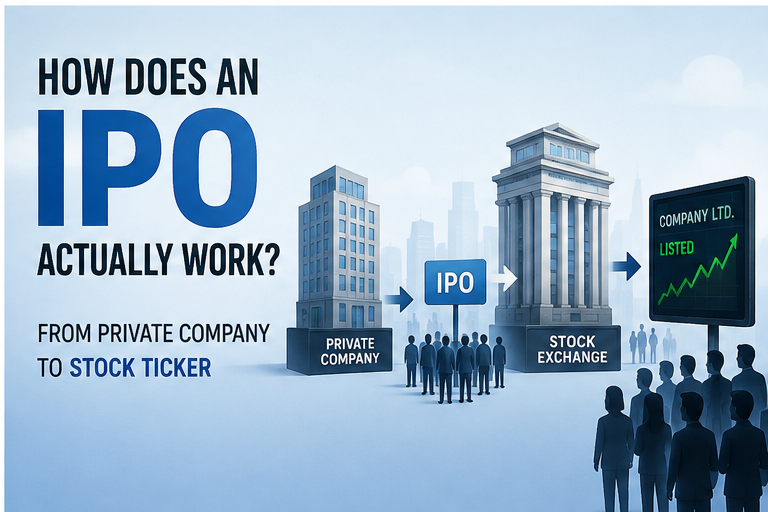
How Does an IPO Actually Work? From Private Company to Stock Ticker
Every company you can buy shares of today - from a large bank to a new-age tech firm - started out as a private company that ordinary investors couldn't touch. An IPO is the specific process through which that changes. Here's what actually happens, step by step.
What an IPO Is
IPO stands for Initial Public Offering - the first time a company sells its shares to the general public and gets listed on a stock exchange. Before this, the company's shares are held only by its founders, early employees, and private investors (like venture capital or private equity firms).
Once it goes public, anyone with a demat account can buy and sell its shares on the open market.
Why Companies Go Public
- To raise capital - money from the IPO typically funds expansion, debt repayment, or new projects.
- To give early investors an exit - founders and early backers can sell part of their holding and realize returns.
- For visibility and credibility - a listed company faces more regulatory scrutiny, which can build trust with customers, partners, and future investors.
The Process, Step by Step
- Appointing merchant bankers - the company hires investment banks to manage the IPO process, including valuation and regulatory filings.
- Filing with SEBI - a detailed document called the Draft Red Herring Prospectus (DRHP) is filed with the Securities and Exchange Board of India, disclosing the company's financials, business model, risks, and how it plans to use the raised funds. This is public and worth reading before investing.
- Price band announcement - the company sets a price range (e.g., ₹95–₹100 per share) rather than one fixed price, within which investors can bid.
- The subscription window opens - usually open for 3 working days. Investors apply through their bank (via ASBA) or broker, specifying how many shares they want at what price within the band.
- Allotment - if the IPO is oversubscribed (more shares applied for than available), allotment is done via a lottery-style process for retail investors. Not everyone who applies gets shares.
- Listing day - the shares get credited to successful applicants' demat accounts, and the stock starts trading on the exchange (NSE/BSE) at whatever price the market is willing to pay - this could be above or below the IPO price.
Retail vs Other Investor Categories
SEBI reserves specific portions of every IPO for different investor types:
- Retail Individual Investors (RII) - individuals applying up to ₹2 lakh, get a guaranteed minimum allocation quota.
- Qualified Institutional Buyers (QIB) - banks, mutual funds, insurance companies.
- Non-Institutional Investors (NII) - high-net-worth individuals applying above ₹2 lakh.
This is why retail investors sometimes have better allotment odds than large applicants during a hot IPO - the retail quota is protected by regulation.
What "Listing Gains" Means
If a stock starts trading above its IPO price on day one, that difference is called a listing gain. It's driven by market demand - how many people want to buy the stock versus how many shares are available - and is not guaranteed. Plenty of IPOs also list below their issue price.
The Takeaway
An IPO isn't just a "hot stock" event - it's a structured, regulated process where a private company opens itself up to public ownership and public scrutiny. Reading the company's prospectus, understanding the price band, and knowing which investor category you fall under all matter far more than chasing listing-day hype.