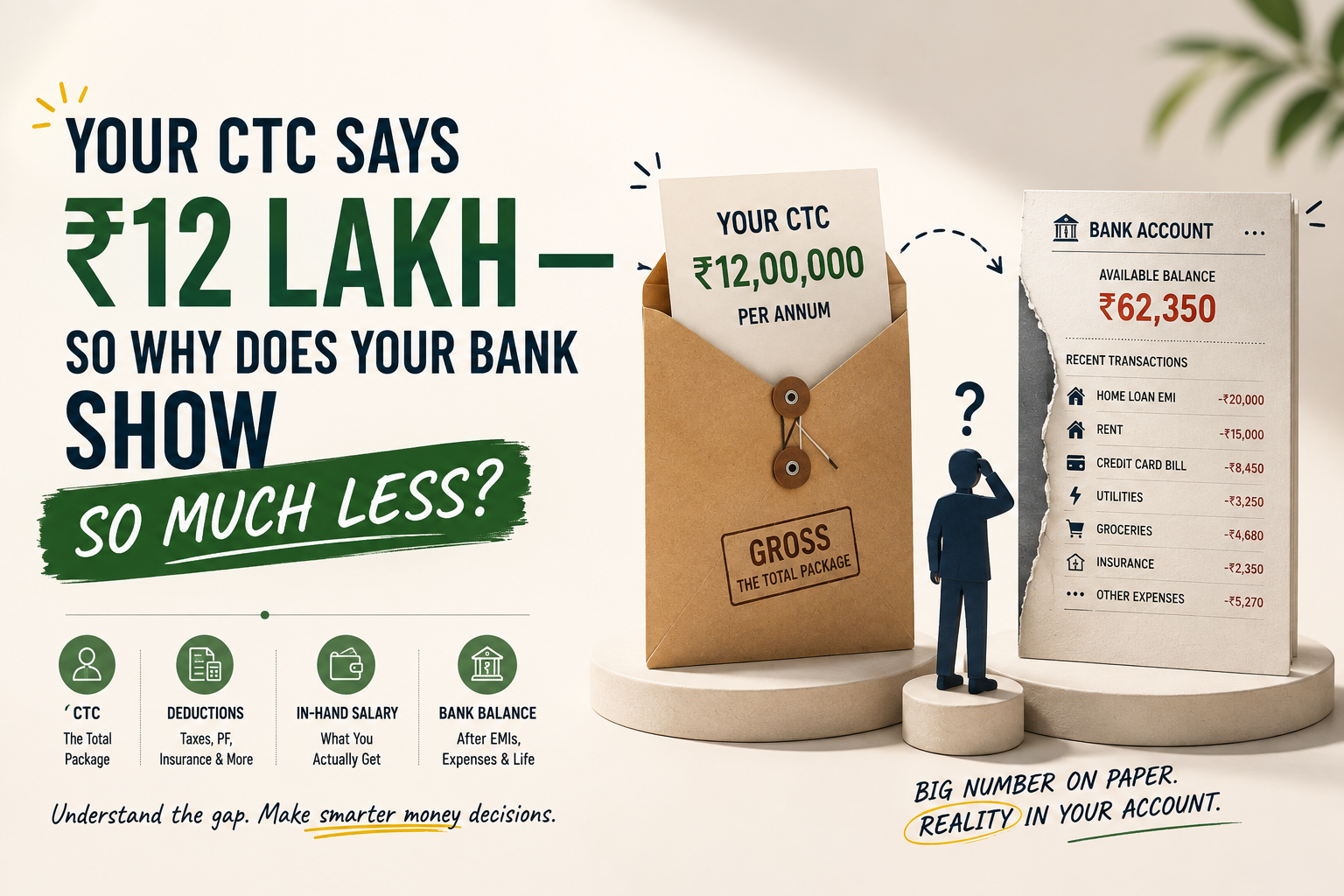
Your CTC Says Rs.12 Lakh - So Why Does Your Bank Show So Much Less?
You accept an offer for Rs.12 lakh a year. Divide by 12, and you expect ₹1 lakh a month in your account. What actually shows up is closer to Rs.75,000–Rs.85,000 - and almost nobody explains why until you're staring at your first payslip, confused.
What CTC Actually Means
CTC stands for Cost to Company - the total amount a company spends on employing you in a year. It's not your salary. It's everything: your salary, plus benefits, plus contributions the company makes on your behalf, plus costs you may never directly see as cash.
What's Hiding Inside CTC
A typical CTC breakup includes:
- Basic Salary - the core component, usually 40–50% of CTC. Most other components are calculated as a percentage of this.
- HRA (House Rent Allowance) - meant to help with rent, and eligible for tax exemption if you actually pay rent.
- Other Allowances - special allowance, conveyance, and similar components that make up the rest of your cash salary.
- Employer's PF Contribution - the company puts money into your Provident Fund on your behalf. This is part of CTC, but you never see it as monthly cash - it goes straight into your retirement savings.
- Gratuity - a benefit paid out only after you complete a certain number of years at the company. It's counted in your CTC from day one, even though you may never touch it for years.
- Insurance premiums - health/life insurance the company pays for you, counted as a cost, not cash.
- Variable pay / bonus - often included in CTC as an annual figure, even though it isn't guaranteed monthly income and may be linked to performance.
What Actually Gets Deducted From Your Salary
Even the "salary" portion of your CTC isn't fully what lands in your account. Common deductions include:
- Employee's PF contribution - typically matches the employer's contribution, deducted from your own salary and moved to your PF account.
- Professional Tax - a small state-level tax, varies by state.
- TDS (Tax Deducted at Source) - income tax deducted directly from your salary every month, based on your estimated annual tax liability.
Putting It Together
In-Hand Salary = CTC − Employer's PF contribution − Gratuity − Insurance/other non-cash benefits − Employee's PF − Professional Tax − TDS
This is why a Rs.12 lakh CTC can realistically translate to roughly Rs.75,000-Rs.90,000 in-hand per month - a meaningful gap, made up almost entirely of components that are real, but not immediate cash in your account.
Why This Confusion Persists
- Offer letters emphasize the CTC number because it looks bigger and is easier to market during hiring.
- Payslips break things into many small line items, making it hard to see the full picture at a glance.
- PF and gratuity are genuinely yours - just not accessible now, which makes them easy to forget when mentally budgeting your monthly income.
The Takeaway
CTC is a useful number for comparing job offers, but it is never your monthly take-home. Before accepting a role - or budgeting your life around a new salary - ask for the in-hand monthly figure directly, or work backward through PF, gratuity, insurance, and TDS yourself, rather than assuming CTC ÷ 12 is what will land in your account.